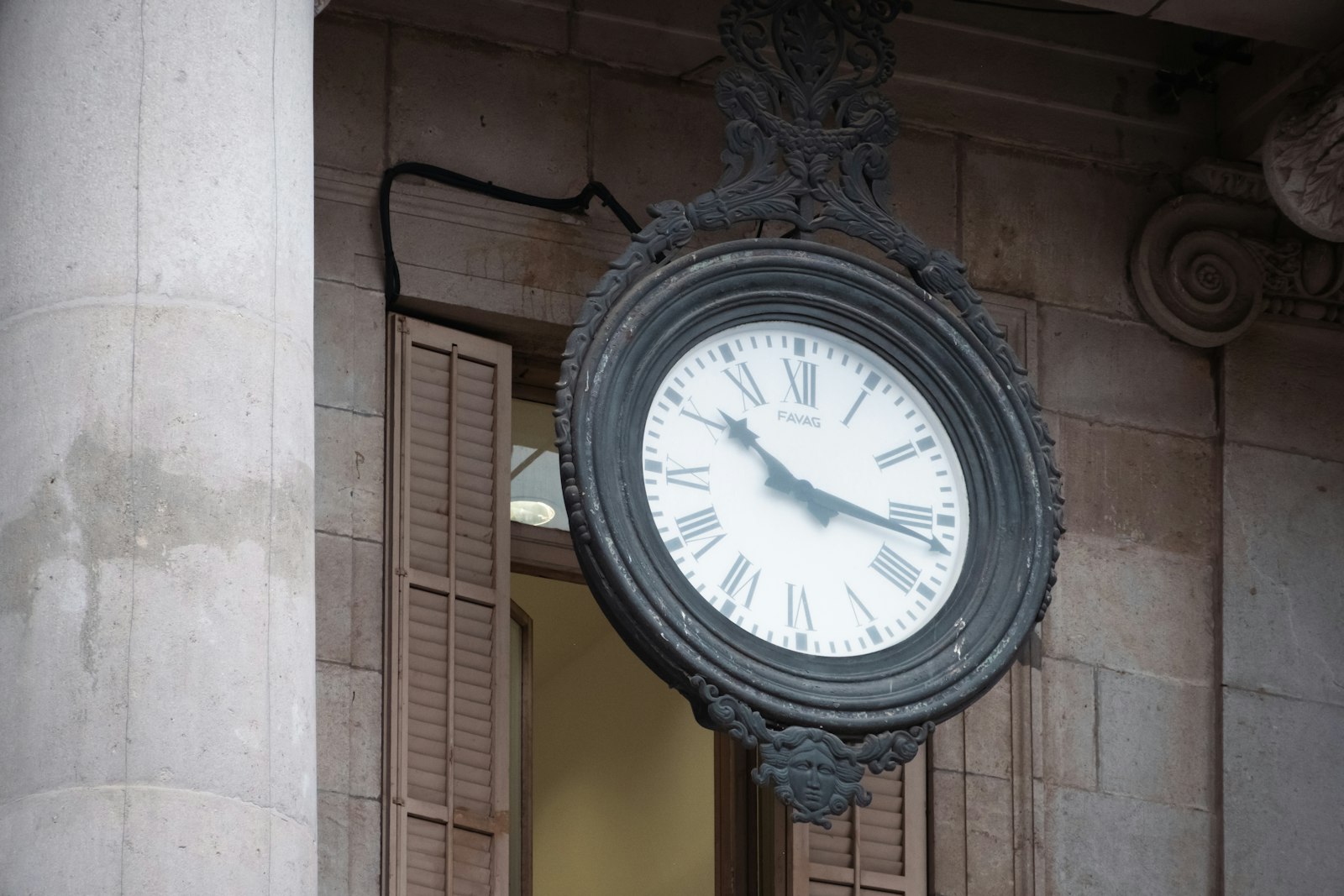
How do you ask the time in Spanish?
The question is singular: ¿qué hora es? — hora here means the moment of the day (the DPD's hora 5.1). The plural ¿qué horas son? is heard in some American countries, mostly in casual speech; the RAE calls it admissible but less recommended.
The answer uses ser, and the verb agrees with the hour: singular for la una and anything built on it, plural for every other hour — es la una y diez, son las diez y media, son las dos menos cuarto (5.2). So never son las una, and never a las una y media: the class starts a la una y media.
The article belongs to the hour: la una, las dos, las tres. Ser vs estar has why the time takes ser even though it changes: son las cinco.
| English | Spanish |
|---|---|
| What time is it? | ¿Qué hora es? |
| It's one o'clock. | Es la una. |
| It's ten past one. | Es la una y diez. |
| It's two o'clock. | Son las dos. |
| It's half past ten. | Son las diez y media. |
| It's quarter to two. | Son las dos menos cuarto. |
How do you say quarter past, half past and quarter to?
Up to half past, say the hour and add the minutes with y: las dos y diez, las tres y veinticinco, y cuarto, y media. After half past, say the next hour and take the minutes away with menos: las tres menos veinte, las cuatro menos cinco, menos cuarto (the DPD's hora 2.1.1). En punto is on the dot: a las nueve en punto.
Quarter to is the trap for English speakers: las dos menos cuarto is 1:45, the next hour minus a quarter — not 2:15.
| Time | Spanish |
|---|---|
| 3:00 | las tres en punto |
| 3:10 | las tres y diez |
| 3:15 | las tres y cuarto |
| 3:30 | las tres y media |
| 3:40 | las cuatro menos veinte |
| 3:45 | las cuatro menos cuarto |
How do they say it in the Americas?
In much of the Americas the minutes come first, with para and the next hour: veinte para las tres, cinco para las cuatro — and quarter to is un cuarto para las diez. Both are right: menos is the general way, para the way of much of the Americas (the DPD's hora 2.1.1).
The preposition is para, never a: un cuarto para las siete, not un cuarto a las siete — the RAE marks the second as not correct (2.1.1).
When it is already the quarter, general Spanish leaves out the article: son y cuarto, son y media. Son las y cuarto is heard in some parts of Spain and the Americas (2.1.1).
| Time | Also said |
|---|---|
| 3:40 | veinte para las cuatro |
| 3:45 | un cuarto para las cuatro |
| 3:55 | cinco para las cuatro |
How do you say a.m. and p.m. in Spanish?
Spanish names the part of the day after the hour: de la mañana from sunrise to noon, de la tarde from noon to sunset, de la noche from dark to midnight, and de la madrugada from midnight to dawn — a stretch de la mañana can cover too: las tres de la mañana (the DPD's hora 2.1).
Noon is las doce del mediodía, de la mañana or del día — never las doce de la tarde, which the RAE marks as not correct (2.1). Mediodía is masculine, el mediodía, never la mediodía, and both a mediodía and al mediodía work (the DPD's mediodía 1). Midnight is la medianoche, las doce de la noche, best written as one word (medianoche 1).
Written in figures, a. m. and p. m. clear up the doubt: 4.30 a. m., 4.30 p. m. Twelve noon can be 12 m., and midnight is 12 a. m. (2.1.2).
| English | Spanish |
|---|---|
| 9 a.m. | las nueve de la mañana |
| 3 a.m. | las tres de la madrugada |
| 1 p.m. | la una de la tarde |
| 9 p.m. | las nueve de la noche |
| noon | las doce del mediodía |
| midnight | la medianoche |
How do you say at what time?
At is a, the a that marks when something happens (the DLE's a 6): ¿a qué hora sale el tren? — a las ocho, a la una. A vs en has why: a marks a moment, en the stretch it falls in — a las ocho, en enero.
About has fixed phrases — a eso de, alrededor de, en torno a — and y pico or pasadas after the hour: vendré a eso de las ocho; eran las diez pasadas (the DPD's hora 3c). A guess about the past takes the conditional: serían las dos y pico cuando salió — it must have been a little after two.
A clock strikes with dar, and dar agrees like ser: dio la una, dieron las tres (5.3).
| English | Spanish |
|---|---|
| At what time does the train leave? | ¿A qué hora sale el tren? |
| at eight | a las ocho |
| at one | a la una |
| at about eight | a eso de las ocho |
| around five in the afternoon | alrededor de las cinco de la tarde |
| a little after two | las dos y pico |
How do you write the time in Spanish?
In words or in figures, without mixing them: las diez de la noche or las 22 h. Las 10 de la noche is not wrong, only less recommended (the DPD's hora 3a). In a story, words; in a timetable, a meeting notice or a report, figures (3b, 3d).
Between the hour and the minutes goes a colon or a period, never a comma: las 9:30 or las 9.30 (4a). The symbol h takes no period — a las 22 h — and no h goes after a. m. or p. m.: 5.30 p. m. (4c, 4d).
One o'clock stays singular even in figures: a la 1:00 h, read a la una — never a la 1:00 horas, because horas is plural (5.4).
The 24-hour clock runs from 0 to 23 — las 22 h is ten at night — and is the usual one for timetables (2.2). Read aloud it takes the minutes as a number — the DPD reads a las 11:30 horas as las once treinta horas (5.4).
Why do English speakers mix it up?
Because English says it's for every hour, and Spanish changes the verb: es la una, son las dos — son las una is the slip the RAE names (5.2). English says at eight o'clock and Spanish a las ocho, never en. And quarter to counts back from the next hour: las dos menos cuarto is 1:45.
Our mistake corpus does not tag telling the time yet, so there is no first-party rate for Nivelo learners on this point — the quiz above is the measure.
What comes after telling time?
Tiempo vs vez vs hora sorts the three words English calls time — hora is the clock — and hace vs desde hace says how long ago and for how long.
Spanish capitalization has the days and the months, small in Spanish: el lunes a las nueve, el 3 de marzo.
Spanish question words are this page's pair: qué, cuál, cuándo and the rest, and the preposition that comes first — ¿a qué hora?
Not sure where your Spanish stands? The Spanish level test takes about five minutes.